Status: Complete · Nov 2025 – Jan 2026 · GitHub
TL;DR#
I built a sentence boundary detector specialized for Azerbaijani legal text, not general-purpose prose. It is a random forest classifier that decides, for every candidate terminator character (., !, ?, ;, quotes, newlines…), whether a sentence actually ends there. Each candidate is described by a 19-character context window plus 9 engineered linguistic and punctuation features. The model reaches 0.958 F1 on boundary detection.
For serving, I compiled the forest with Treelite and deployed it on NVIDIA Triton Inference Server (FIL backend) behind a FastAPI service. Inference latency dropped from 76ms to 3ms, a 25× speedup.
Problem: Why Legal Text Breaks Sentence Splitters#
Sentence splitting is the first step of almost every NLP pipeline (chunking for retrieval, summarization, translation), and errors here propagate everywhere downstream. Legal documents are the hardest case: laws, regulations, court decisions and contracts are dense with abbreviations, numbered clauses, nested lists and citations. Splitting on . breaks immediately on Azerbaijani legal text:
- Abbreviations:
prof.,məs.,mln.,kv.m.,Ph.D., initials likeƏ.M., Roman numerals likeXIV. - Enumerations:
1.,a),(iii), bullet symbols, and lists introduced by legal formulas like “aşağıdakılar müəyyən edilir:” (“the following are established:”) or “tərəflər aşağıdakılar barədə razıdır:” (“the parties agree on the following:”) - Quotes: a closing quote may or may not end the sentence, depending on balance and what follows
- Semicolons and colons: they end clauses inside lists, but sometimes end sentences
General-purpose splitters are tuned for English, everyday prose and Wikipedia-style text. They miss both Azerbaijani-specific abbreviations and the structure of legal documents. Neural models would handle this, but they are overkill in cost and latency for a step that runs on every document.
Approach: Character-Level Classification#
The design follows the structure of the CharBoundary library, adapted for Azerbaijani.
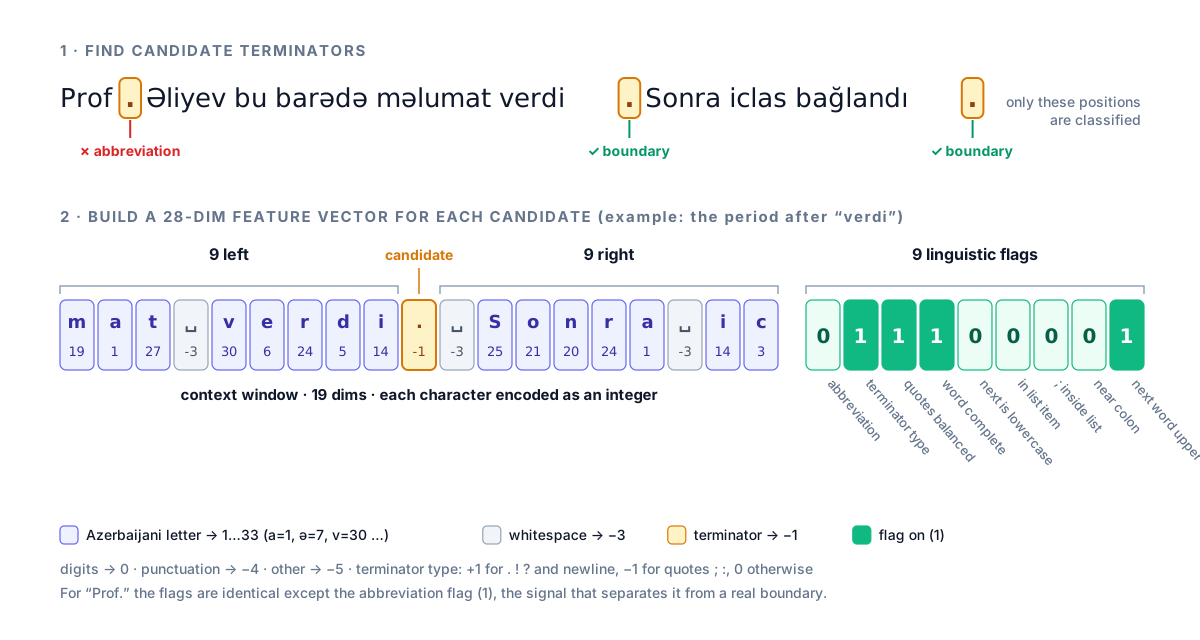
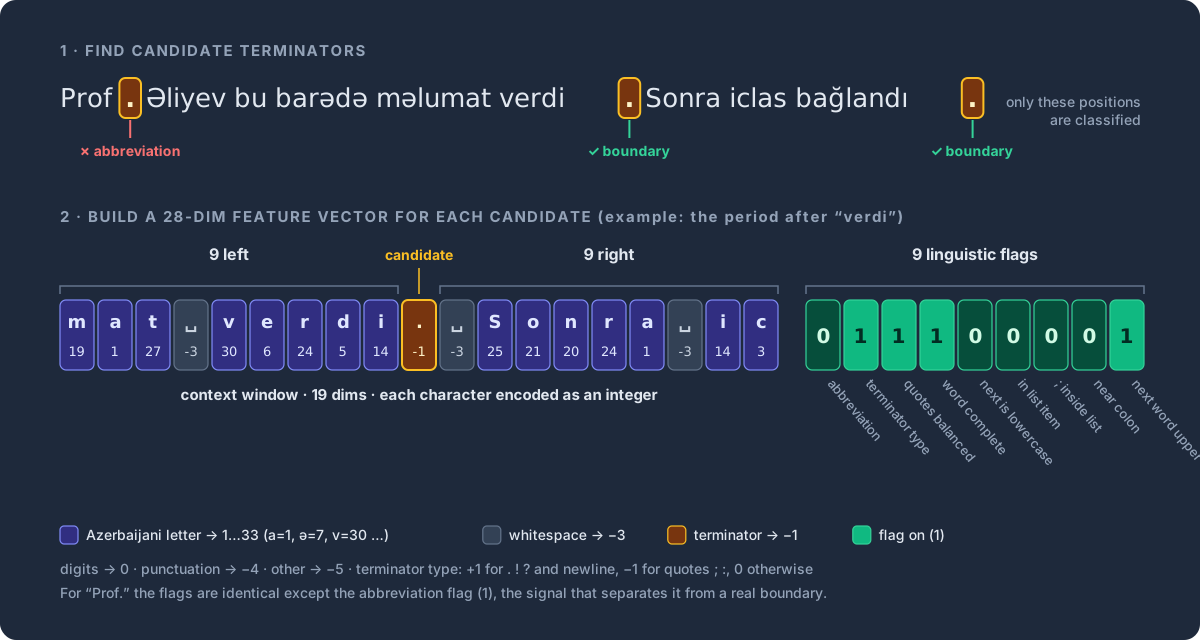
1. Candidate detection. Only characters that could end a sentence are classified. Everything else is skipped, so the model sees a small fraction of the text.
2. Character encoding. Each character is mapped to an integer by type: Azerbaijani letters (all 33, including ə, ğ, ı, ş, ç, ö, ü) get their own IDs; digits, terminators, whitespace, punctuation and other characters get category codes.
3. Feature vector (28 dims) for each candidate position:
| Features | Dims | Description |
|---|---|---|
| Context window | 19 | Encoded characters, 9 to the left + the candidate + 9 to the right |
| Abbreviation flag | 1 | Token ending at this period is in an 830+ entry Azerbaijani abbreviation list |
| Terminator type | 1 | +1 primary (. ! ? newline), −1 secondary (quotes, ;, :), 0 otherwise |
| Quote balance | 1 | Are straight and curly quotes balanced up to this point? |
| Word completion | 1 | Does a closing quote look like it ends a word? |
| Followed by lowercase | 1 | Next character is lowercase, a strong “not a boundary” signal |
| In list item | 1 | Near a list marker (1., a), (ii), •…) or list conjunction (və, və ya, həmçinin…) |
| Semicolon in list | 1 | ; separating list items rather than sentences |
| Near colon | 1 | Proximity to a list-introducing colon |
| Next word uppercase | 1 | Next word starts with a capital letter |
4. Classifier. A random forest (128 trees, max depth 32) trained on labeled Azerbaijani text. Training and evaluation use a 0.75 probability threshold, which favors precision: a missed split is cheaper downstream than a wrong one.
5. Preprocessing. Training text is normalized first: Cyrillic and Greek look-alike characters are mapped to Latin (а → a, ә → ə), and chunks with characters outside the Azerbaijani alphabet are dropped.
Serving: Triton FIL#
The random forest in scikit-learn was the latency bottleneck at 76ms. The fix was to stop running it in Python:
- Treelite compilation. The trained forest is converted to a Treelite checkpoint.
- Triton FIL backend. Triton’s Forest Inference Library runs tree ensembles natively on NVIDIA GPUs (or CPU) and returns class probabilities.
- Dynamic batching. Triton merges concurrent requests into batches of up to 1,024 candidates, with a 5ms max queue delay.
- FastAPI front end. The API extracts features, calls Triton over gRPC, and splits the text at positive predictions.
Result: 76ms → 3ms (25×).
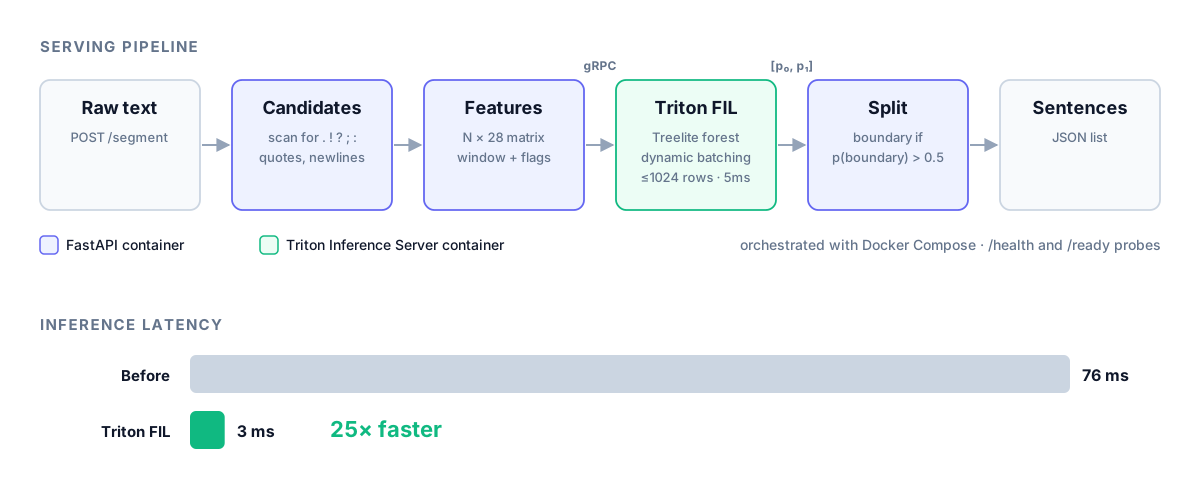
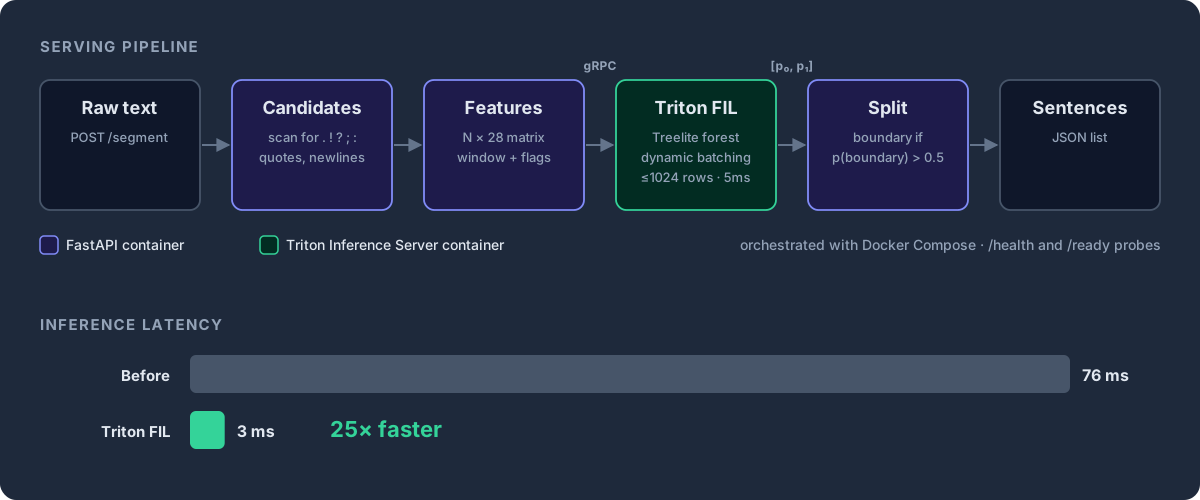
The whole stack runs under Docker Compose: Triton plus the API, with health checks that separate liveness (/health) from readiness (/ready, meaning Triton is reachable and the model is loaded).
curl -X POST http://localhost:8000/segment \
  -H 'Content-Type: application/json' \
-d '{"text": "Bu birinci cümlədir. Bu isə ikinci cümlədir."}'Results#
| Metric | Value |
|---|---|
| Boundary F1 | 0.958 |
| Latency (scikit-learn) | 76ms |
| Latency (Triton FIL) | 3ms |
| Speedup | 25× |
| Feature vector | 28 dims |
| Model | Random forest, 128 trees, depth 32 |
Team#
Built together with Turan Abbasli and Rashad Mammadov.
Stack#
Python · scikit-learn · NumPy · Treelite · NVIDIA Triton Inference Server (FIL) · gRPC · FastAPI · Docker Compose
Code on GitHub.